Key Findings
- AI has transformed medical education attitudes in 24 months: Harvard Medical School's AI Ph.D. track received 400 applications for 7 available spots in Fall 2024, signalling demand that has outpaced institutional capacity.
- AI has "democratized the feeling of knowing without the burden of understanding" — students across medicine, arts, and education now produce technically correct outputs that lack contextual depth and judgement.
- The defining challenge is not AI itself but a temporal mismatch: technologies that once took generations to integrate now transform society in months, while human cognitive and institutional development maintains its biological pace.
The Question on the Table
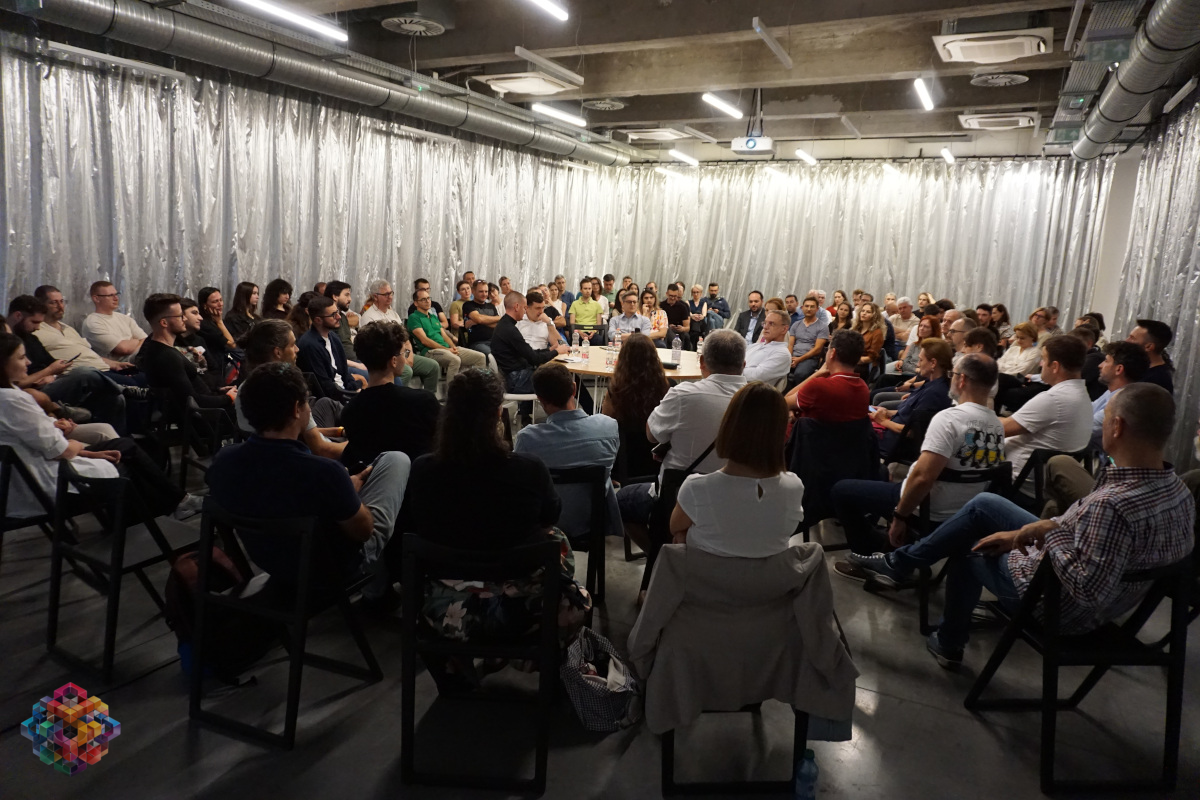
In a packed auditorium in Timișoara, Romania, five experts from disparate fields gathered to address a question increasingly central to contemporary life: how prepared is humanity for the artificial intelligence revolution already underway? The question sounds abstract, even routine in 2024, yet the first ABQ Dialogues session demonstrated how concretely and quickly the implications land when you bring together a molecular biologist, an artistic director, a parish priest, a political scientist, and a social geographer in the same room.
The session's central premise was deceptively simple: rather than debating AI's theoretical implications, the panel revealed something more immediate — the compression of evolutionary time itself. Technologies that once took generations to integrate now transform society in months, while human development, cognitive, social, and institutional, continues at its biological pace. Whether we are prepared for this mismatch is not a rhetorical question. It is a policy and civilisational question with measurable consequences already unfolding.
What "400 Applications for 7 Spots" Tells Us
Prof. Dr. Ovidiu Sirbu described a complete reversal in medical attitudes toward AI in just 24 months. Two years prior, mentioning AI in medicine triggered defensive reactions from colleagues who insisted it would not replace them. Then, approximately one year before the session, everything changed. His university was preparing to launch AI courses specifically for medical professionals, with enrollment predicted to exceed capacity. Harvard Medical School's new AI in Medicine Ph.D. track, launched in Fall 2024, crystallised the scale: seven available spots, 400 applications.
The ratio — nearly 57 applicants per place — is not simply a supply-and-demand story about a fashionable field. It signals something more structurally significant: institutions designed for one rate of change are being asked to absorb demand generated at a completely different rate. The infrastructure of higher education, which measures its planning cycles in academic years and its curriculum reforms in decades, is being confronted with a market signal that updates on a quarterly cadence. This is the institutional lag in its starkest form: the demand exists, the urgency is real, but the pipes to channel it have not been built.
The clinical implications compound the educational ones. Patients now arrive at consultations with ChatGPT printouts, confident in self-diagnoses. While some bring useful information, others begin unsupervised treatments based on misunderstood recommendations, developing complications from herbal supplements that no medical protocol would sanction in their prescribed combination. The doctor is no longer solely responsible for the patient's knowledge — but remains wholly responsible for the outcome.
The Temporal Mismatch Problem
The panel's most structurally important insight was not about any specific technology but about the relationship between different rates of change. Human cognition develops over years. Institutional cultures solidify over decades. Legal and regulatory frameworks evolve over generations. None of these timelines have accelerated. What has accelerated, dramatically, is the technology layer that sits on top of all of them.
Previous technological revolutions — print, electricity, the automobile, the internet — each took decades to fully permeate societies. The interval between invention and mass adoption gave institutions time, imperfect and sometimes brutal time, to adapt. Workers could retrain. Laws could be written. Norms could form. AI's current trajectory compresses this interval in ways that have no historical precedent. A model that reshapes professional practice can go from research publication to global deployment in months. The institutions that are supposed to govern, educate around, and make social sense of that model are still writing their first policy documents.
Dr. Alexandru Dragan's team illustrated the research upside: using AI to analyse protest patterns across media content in multiple languages, extracting stress indices from press articles to predict social unrest in ways that would have been computationally impossible just years ago. The same technology enabling this research capability is simultaneously eroding the critical thinking skills that would be needed to evaluate its outputs responsibly.
Knowing Without Understanding
The session's most resonant formulation came from the accumulated observations of multiple panelists: AI has democratised the feeling of knowing without the burden of understanding. Students across medicine, the arts, and education now produce technically correct outputs — essays, clinical summaries, exhibition texts — that lack contextual depth and the judgement that comes from having wrestled with a problem.
Prof. Dr. Sirbu described abandoning conventional essay assignments in favour of oral examination using a maieutical format — the Socratic method of sustained questioning — precisely because written outputs can no longer be reliably attributed to genuine reasoning. Diana Marincu, Artistic Director of the Art Encounters Foundation, observed that she can identify AI-generated exhibition texts immediately and pointed to a more profound challenge: when images pass through multiple AI filters and alterations without disclosure, the reference to the original disappears. The boundary between authentic and synthetic becomes indiscernible.
Dr. Vlad Botgros offered the starkest educational diagnosis: global IQ has been declining since the late 1990s and early 2000s despite improving socioeconomic conditions, and the most plausible hypothesis implicates technology. University professors now face a structural impossibility — competing with platforms engineered for maximum engagement against 10-second attention spans — while students pose fundamental questions about why they should learn anything an algorithm can retrieve on demand. His prediction: in five years, universities will be very, very empty if they do not adapt.
Across the Table: Five Perspectives
The session's richness came from the breadth of disciplines assembled. Prof. Dr. Ovidiu Sirbu (Molecular Biology and Genomics) brought the clinical and research perspective, documenting both AI's transformative potential in medicine and the social complications of patient self-diagnosis. Diana Marincu (Artistic Director, Art Encounters Foundation) articulated the crisis of authenticity in the arts — the challenge of a technology that can mimic creativity without possessing the intention or self-doubt that makes art meaningful. Fr. Istvan Barazsuly SDS (Parish Timișoara III Elisabetin) drew connections between technological dependence and classical theological concepts of idolatry, observing that the smartphone — touched an average of 2,500 times daily — becomes an intermediary that distances people from genuine relationship. Dr. Vlad Botgros (Political Science and Sociology) diagnosed the structural conditions of democratic vulnerability when algorithmic influence outpaces institutional authority. Dr. Alexandru Dragan (Social and Economic Geography) documented both AI's research potential and the widening rural-urban education gap that technology amplifies rather than bridges.
"The technology doesn't care about our readiness. The question is whether our institutions will catch up before the cost of unpreparedness becomes irreversible."
What This Means for Decision-Makers
For organisations operating in education, healthcare, policy, and professional services, the session produced several practical implications. First, institutional adaptation cannot wait for consensus — the pandemic demonstrated that years of resistance to digital tools evaporated in weeks when survival demanded it. The capacity for rapid institutional change exists; the question is whether societies will exercise it proactively or reactively.
Second, assessment and credentialing frameworks require fundamental redesign. When AI can generate technically correct outputs across most professional domains, the value-added by human expertise must be demonstrated through judgement, contextualisation, and the ability to ask the right questions — not through the production of text. Organisations that continue evaluating outputs rather than reasoning will systematically misread competence.
Third, the biological inequality frontier opened by AI is not a distant concern. Molecular biology has already produced breakthroughs in cellular rejuvenation and reproductive technology that will concentrate benefits among those with the resources to access them. The temporal mismatch problem is not only about readiness for what AI does today — it is about having governance structures in place before enhancement technologies create divisions that become heritable.
The panel concluded without consensus, because the question of preparedness itself resists resolution when the rate of change exceeds comprehension. What the session modelled instead was what genuine preparation looks like: sustained interdisciplinary dialogue, intergenerational exchange, honest acknowledgement of uncertainty, and a commitment to human dignity even while accepting technological inevitability. That the conversation must continue, at a human pace in algorithmic times, is not a failure. It is the only viable response.
Cite this analysis
ABQ Institute. "Are We Prepared for This? — AI, Society, and the Pace of Change." ABQ Dialogues Season 1, #1. Timișoara, Romania: ABQ Institute, 2024. Available at: https://abq.institute/insights/are-we-prepared