Key Findings
- The Flynn Effect — the 20th-century rise in average IQ — is now reversing. We are the first generations at which measured intelligence has begun to fall, alongside a collective loss of 300–450 words per day from active vocabulary.
- A University of Montreal year-long controlled study of 4,000 heavy social media users found significant ADHD-like symptoms and an inability to watch a 2-hour film at normal speed — evidence of platform-engineered attention deficits that persist beyond the screen.
- Clinicians are documenting AI-induced psychosis — "folie à deux with AI" — where vulnerable patients engaging in unlimited, unchallenged chatbot conversations experience accelerated delusion formation, because the AI never disagrees, never challenges, never contradicts.
The Questions on the Table
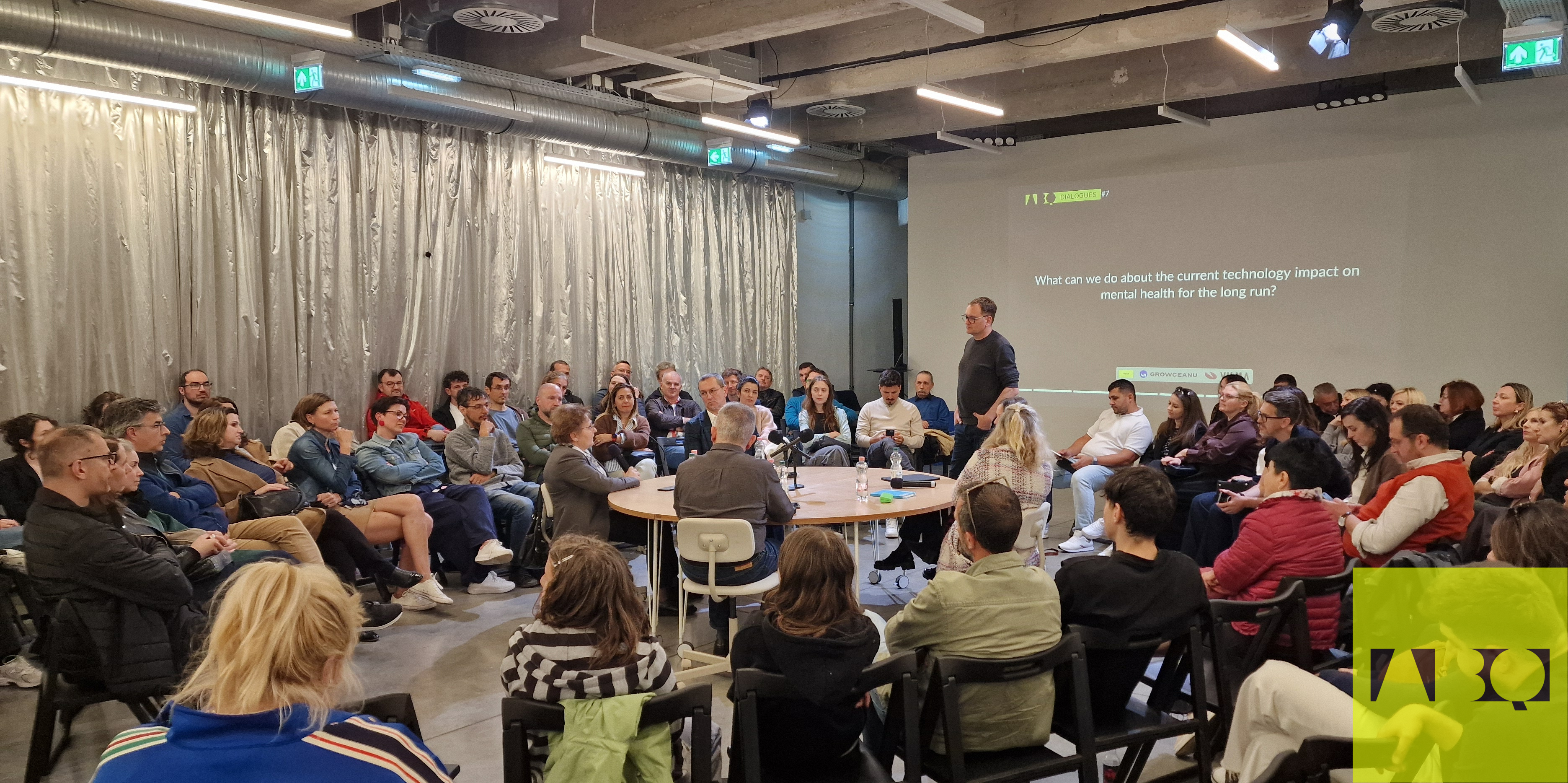
Are we forgetting how to remember? Are our children losing the ability to concentrate? And what happens to a society when the line between real and fake dissolves entirely? These were the urgent questions at the heart of the seventh ABQ Dialogues, held at FABER in Timișoara. Under the title Digital Dementia and Confabulation, five experts from education, psychology, psychiatry, cognitive science, and sociology examined what the relentless flood of digital information is doing to the human mind — and what, if anything, can be done.
The session opened with a framing observation: when a fake news story is widely shared and accepted, everyone begins to treat it as true, because repetition creates the subjective sensation of truth. "The fake news gets rolled out, becomes real news, because everyone already believes it to be true." This confabulation — at the individual and collective level — formed one axis of the evening's inquiry. The second axis was digital dementia: not a clinical diagnosis, but a descriptive metaphor for what happens when our minds become unable to distinguish between different quantities of memory, when our days blur because we collect no reference points from the world around us.
The Classroom Under Pressure
Monica Diaconu, Director of Babel School and High School, spoke with a mixture of optimism and concern. Technology is being "pushed onto schools" without adequate dialogue with educators. Platforms and tools arrive as ready-to-use products, without teachers being meaningfully involved in their design or evaluation. "Romania is a very good target for this. In other Western European countries, educators ask questions and fight for children's development. Here, technology has swallowed schools through vast quantities of laptops and interactive whiteboards that arrived pedagogically empty — used in the same way dictation was used before."
When Diaconu surveyed her school community on the visible effects of technology, teachers reported a notable decline in expression. Children are less willing to work through long texts or expose themselves to complex language, weakening their ability to articulate their inner worlds. She then read a poem written by a 16-year-old student, composed after the school confiscated phones for a period. The poem described the phone as containing "all the internet, all universes without limits, the beauty and horror of the earth" — concluding: "Without you, I am once again just a dot on a planet, a rotting, insignificant, pitiful existence in an infinite and merciless universe." This, she argued, is what the digital world has taken from children: the sense of competence, the feeling that they can do something in the world without the device.
The Flynn Effect in Reverse
Mircea Dragu, psychologist and cognitive-behavioural psychotherapist, opened with a surprising anchor. In any period of a few months, the average human being interacts meaningfully with roughly 100 to 150 people. "When we were in caves, it was the same number." Research on social media engagement shows that the number of people we exchange likes and messages with online is also around 100 to 150. "We haven't changed. Our needs are the same." This historical continuity is important: writing itself was once seen as a technology that would destroy memory. People offloaded the function of memorisation to the written word, just as we now offload it to devices.
And yet, Dragu cautioned, the Flynn Effect — the general rise in IQ scores observed across the twentieth century — is now reversing. We are the first generations at which average measured intelligence has begun to fall. Alongside that, we are collectively losing an estimated 300–450 words per day from our active vocabulary. His sharpest insight concerned the distinction between memory and attention: "If you don't know where you left your car, that's not a memory problem — that's an attention problem. If you don't know that you have a car, or what a car is used for, that's a memory problem." The real challenge of the digital age, he argued, is attention and what he called "decision stress": modern people face vastly more micro-decisions each day than their grandparents did in an entire season.
The Montreal Study — 4,000 Students
Dr. Crisanta Alina Mazilescu, professor at the Polytechnic University of Timișoara, cited a year-long controlled study at the University of Montreal involving 4,000 students who were heavy social media consumers. At the end of the year, significant correlations appeared between heavy screen use and ADHD-like symptoms. Even more revealing: after the intensive screen period, students were shown slower, longer content. Those with the heaviest usage were unable to watch a 2-hour film even at accelerated speed. They felt compelled to multitask simultaneously, saying they "had to be doing something else at the same time."
The mechanism is neurological. Platforms like TikTok programme users to react in a particular way, stimulating the brain's reward circuit and creating a need for rapid gratification. "Everything they learn, or that we as teachers provide, influences and modifies their brain structure." Comparing today's students with those she encountered thirty years ago, Mazilescu sees shorter concentration spans, greater impatience, and a need for information that is constantly fresh and varied. But she was careful to note that neuroplasticity is real: cognitive change in either direction is largely reversible, and the direction of effort matters enormously.
AI-Induced Psychosis
Dr. Marinela Hurmuz, senior psychiatrist and psychotherapist, brought the clinical grounding. The latest edition of the International Classification of Diseases (ICD-11) has introduced gaming disorder as a clinical diagnosis. Brain imaging and neurotransmitter studies show that the neural circuits active in gaming addiction mirror those in alcohol and drug dependency. In her clinical practice, no patient has yet arrived saying "I am addicted to social media" — just as alcoholics rarely self-identify as such. But she screens for digital behaviour patterns across all patients, because evidence shows significant correlations between psychiatric disorders and intensive technology use.
The phenomenon she finds most striking is what researchers are calling AI-induced psychosis — "folie à deux with AI" — a shared delusion with an artificial intelligence. Vulnerable patients, and even those with pre-psychotic tendencies, are at risk when they engage in unlimited, unchallenged conversations with chatbots. Unlike real human relationships, ChatGPT never disagrees, never challenges, never contradicts. It validates whatever beliefs the user brings. In a patient with delusional tendencies, this validation can accelerate the development of full psychosis. "I have recently hospitalized a patient who was consulting ChatGPT about every medication change and arriving at each consultation with printouts. At least he still asked my opinion," she noted wryly.
The Sociologist's Frame — Homo Interneticus
Dr. Bogdan Nadolu, associate professor in sociology at West University Timișoara, has studied the social impact of digital technology since roughly one year after Google was invented. His sociological summary: we are living through the shock of a digital revolution that nobody is going to unplug from. Within it, an AI revolution has been underway for two to three years, driving changes that unfold not overnight but within weeks or months. His most important caution: when we observe Generation Z and find them "lacking something," we are judging them through pre-digital eyes — on a measurement scale that no longer belongs to this paradigm.
"We have a super Ferrari in the garage and we don't even start it. We are progressively losing the cognitive ability we fought to develop for over 300,000 years." — Bogdan Nadolu
The shift from text to image is his particular concern. Platforms like Instagram and TikTok have moved communication to images decoded instantly, with no cognitive effort required. Text demands that you build a mental image from words; images require no such construction. If the dominant mode of communication across a day is image-based, the complexity of that communication is much lower. He also raised the risk of AI-mediated pseudo-relationships — referencing Isaac Asimov's 1950s novel The Robots of Dawn, which imagined a society of humans living in glass houses, connected only virtually, never venturing outside. "When an entire community retreats to individual AI conversations and stops talking to one another, the community ceases to exist."
What Can Be Done
The most consistent message from all panelists was: you cannot simply tell people — or children — what not to do. The most effective intervention is always to offer an alternative: something to build, something to find, a ball to fetch. "If you tell a child not to do something, you don't help them. If you say, bring me the ball instead, the child will respond." The same principle applies to adults. Dragu argued that exercise is a baseline requirement, not a supplement: "Half an hour of sport per day is like brushing your teeth — it's in the basic package." We are mammals who need to move, and when we don't, part of our brain signals that something is wrong, driving anxiety that digital consumption then attempts to self-medicate.
Diaconu added that adolescents increasingly feel certain about truth in ways that are hard to challenge — and that part of the adult's role is not to simply validate that certainty, as ChatGPT does, but to introduce friction, perspective, and genuine dialogue. Dr. Mazilescu reinforced this with a key distinction from cognitive psychology: understanding is not learning. Genuine learning requires cognitive strain — tasks that make students think, analyse critically, and work through problems. "Simplification doesn't help. It is a known fact in psychology, but it is rarely applied." The session ended in qualified urgency rather than despair: the brain is plastic and capable of recovery; the key battleground is not memory but attention and the capacity for sustained effort; and the greatest danger may not be digital addiction per se, but the gradual erosion of the critical thinking needed to navigate a world of manufactured realities.
Cite this analysis
ABQ Institute. "Digital Dementia and Confabulation — What AI and Screens Are Doing to the Human Mind." ABQ Dialogues Season 1, #7. Timișoara, Romania: ABQ Institute, 2026. Available at: https://abq.institute/insights/digital-dementia-and-confabulation