Key Findings
- OpenAI–Ginkgo Bioworks AI-controlled robotic equipment executed 36,000 experiments in weeks, reducing timelines and costs by 30–40 per cent — signalling that biology is industrialising at software speed.
- Timișoara ranks 3rd or 4th globally by HTGAA participants: 38 enrolled locally, 10 doing remote lab work across Tokyo, San Francisco, London, and Ottawa — a world-class life-science footprint largely invisible to the city itself.
- The health paradigm is shifting from treatment to continuous prevention: by 2036 the default will be constant biomarker monitoring and biological risk optimisation — "forever healthy, not forever young."
Biology Becomes Prescriptive
For most of human history, biology was a descriptive science. Biologists watched, classified, and catalogued. After the Second World War they discovered a transmittable code layer controlling the details of every living organism. Seventy years and dozens of Nobel Prizes later, humankind not only understands the rules of that code but has learned to read, write, and edit it — transforming biology from a descriptive into a prescriptive science.
The convergence is happening at the highest levels. Google DeepMind employees win Nobel Prizes for protein design tools. OpenAI collaborates with Ginkgo Bioworks. Nvidia builds custom hardware suites for genomics research. Stripe funds Arc Institute researchers on startup-logic timelines. Jeff Bezos lends his name and capital to a Sustainable Protein Centre. The tech founders who survived Steve Jobs seem to confirm his prediction: the biggest innovations of the twenty-first century will come at the intersection of biology and technology.
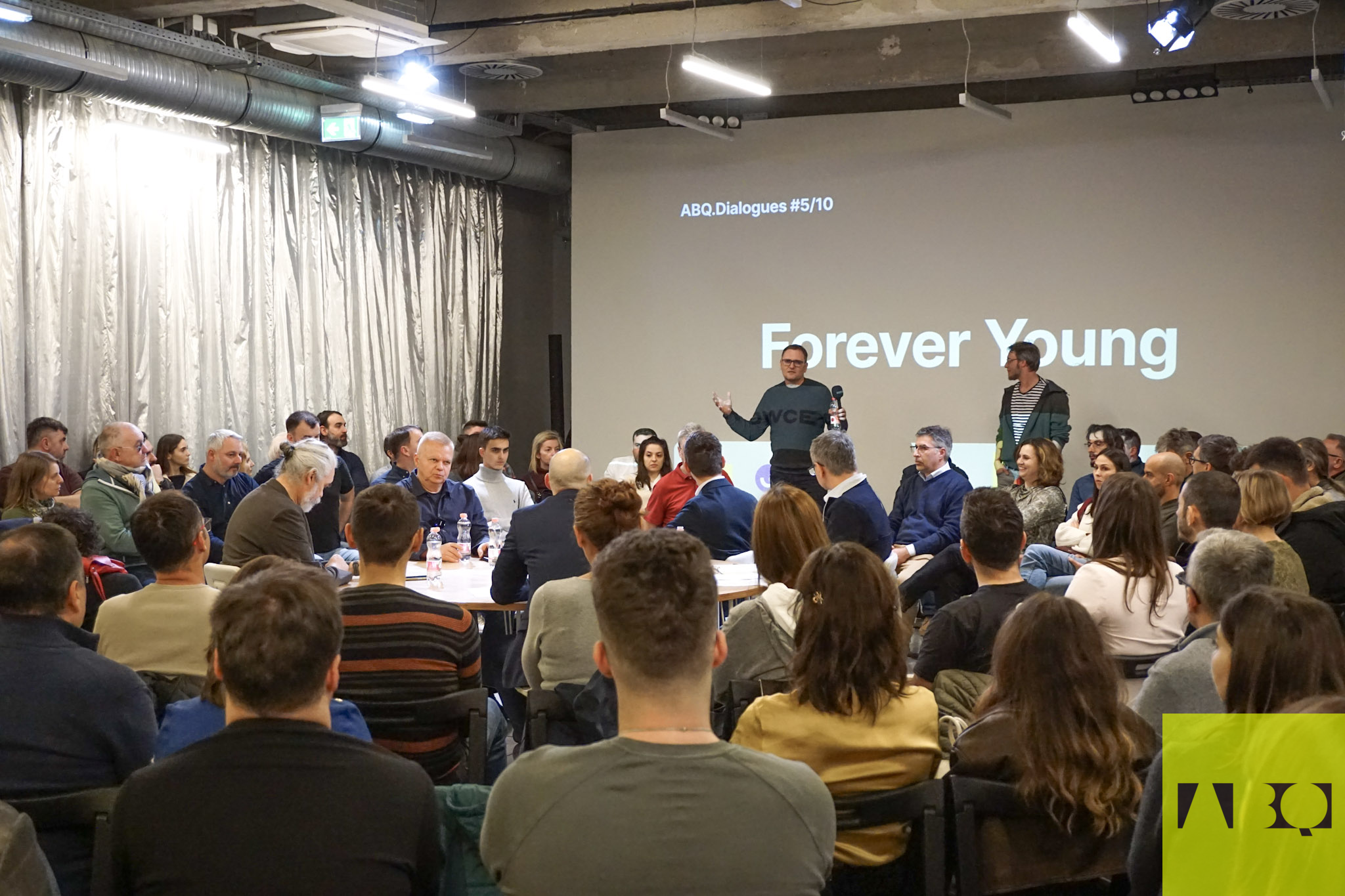
Against this backdrop, the fifth ABQ Dialogues session brought five speakers and a full room together at FABER in Timișoara for three hours of debate on bioengineering, longevity, and what a mid-sized Romanian city can do to claim a seat at the global life-sciences table.
Three Technology Families Reshaping Health
Dr. Octavian Jurma offered a structured overview of the three technology families with the greatest near-term impact on human health. The first is mRNA technology — made famous by COVID-19 vaccines but now entering clinical trials for cancer. The pandemic investment shortened vaccine development from ten years to eleven months, and the platform is now being repurposed for oncology. The irony, Jurma noted, is that the resulting anti-vaccination backlash has caused immunisation rates to decline, converting progress into partial regression.
The second family is CRISPR and its descendants. The Nobel Prize came in 2020; by 2026 several CRISPR-based therapies have passed clinical trials. The newer generations — base editing and prime editing — correct single-letter and phrase-level errors in DNA without cutting the double strand. This opens the door to direct in-vivo editing: a mechanic who goes in and replaces exactly the faulty letter in the instruction manual, delivered through mRNA vectors and lipid nanoparticles. Third is artificial intelligence in genomics. The human genome contains roughly three billion base pairs — the equivalent of a thousand Bibles. No human team can parse data at that scale at the individual level. AI promises to enable genuinely personalised genetic medicine at an accessible price. "Biology is starting to behave like software," Jurma said. "We can intervene and modify the code. The bottleneck is no longer innovation but our willingness and capacity to regulate."
36,000 Experiments in Weeks
Radu Ticiu shifted the conversation toward the industrialisation of biology. He described the OpenAI–Ginkgo Bioworks collaboration in specific terms: AI-controlled robotic equipment executing 36,000 experiments in weeks, reducing timelines and costs by 30–40 per cent. The human genome contains roughly three billion base pairs — that volume of data cannot be handled with a pipette. But the scale of AI-driven biological research also generates new failure modes. One research group generated so many candidate protein structures in a few months that proper validation would take two hundred years.
He also raised the cautionary case of golden rice — a genetically modified variety engineered to address vitamin A deficiency, blocked from market in many countries on anti-GMO grounds while 250,000 children lose their sight each year from the deficiency. Dan Fanu brought the entrepreneur's balance: many interventions that work in C. elegans or mice do not translate to larger animals, and some high-profile longevity research remains controversial on reproducibility grounds. "But if you're in the technology world and you see what's happening, you think it's only a matter of time. We need people who promise. Because if we say it can't be done, we close the subject and nobody does anything."
Forever Healthy, Not Forever Young
There was broad agreement on a central prediction for the decade ahead: the default health paradigm will shift from treating illness to managing health continuously. Michael Bogdan Mărgineanu was specific: centralised laboratory diagnostics will give way to home-based biomarker monitoring, constant and personalised. Longevity clinics, currently a premium service, will become as common as gyms. The enabling factor will be AI-driven data processing and automation.
"I would rather live eighty years without Alzheimer's than a hundred years plus forty of cognitive decline. The goal is not forever young. It is forever healthy." — Octavian Jurma
Jurma predicted that arriving at hospital with a full-blown disease would come to be seen as a failure of the prevention system. The default in 2036, he said, will not be immortality but continuous optimisation of biological risk — closer to the regular tuning of a car, where specific components are recalibrated to return the body to normal operating parameters. Horațiu Moldovan presented a practical hierarchy for extending healthspan: social relationships first (citing a 75-year Harvard study showing social connection quality as the strongest predictor of longevity), followed by sleep, nutrition and movement, and supplementation.
What Timișoara Can Do
Ticiu surprised the room with an inventory of existing local activity. Timișoara is the third or fourth city in the world by HTGAA participants — 38 enrolled locally, 10 of them committed learners doing remote lab work in Tokyo, San Francisco, London, and Ottawa, four of them high-school students. A biomanufacturing facility representing a €30 million investment is under construction to convert plant residues into industrially useful substances. A team of seven Timișoara-based engineers works for a startup with $550 million in funding building autonomous laboratory equipment for what it calls "scientific superintelligence."
Mărgineanu brought the perspective of BioMentorHub, which ran Timișoara's first biotech entrepreneurship bootcamp the previous year. The biggest obstacle, he argued, is not a shortage of ideas or funding instruments — it is the absence of investible biotech startups, because the transfer pipeline from university research to incorporation is clogged. "We keep talking about money and technology. But without a strategy to attract, retain and support talented researchers in a healthy organisational culture, none of this will work."
Jurma closed with a cultural argument under the banner of "Rock the Tech." Timișoara resembles Seattle, he said — a mid-sized city producing disproportionate cultural and economic value. The city's rock heritage encodes values that map directly onto breakthrough innovation: experimentation, risk-taking, interdisciplinarity, tolerance of failure, and long-term vision. Two former Timișoara medical graduates are now in Los Angeles — one involved in two successful biotech startups, the other heading research at Gilead Sciences. Both want to contribute back. The question is whether the city can create conditions to receive them.
Cite this analysis
ABQ Institute. "Forever Young — Bioengineering, Longevity, and What Timișoara Can Do." ABQ Dialogues Season 1, #5. Timișoara, Romania: ABQ Institute, 2025. Available at: https://abq.institute/insights/forever-young