Key Findings
- Romania's AI adoption rate sits at approximately 2% nationally — versus 8% across Europe and 14% in leading EU markets — putting its outsourcing-dependent tech sector at existential risk as AI eliminates geographic labour cost advantages.
- Net salaries in Timișoara have exceeded those in Barcelona and Austria, collapsing the price-performance rationale that made Romania a nearshore destination. Romania must now compete on competence, not cost.
- Approximately 90% of AI projects initiated in organisations fail or remain stuck in optimisation mode; success requires adapting technology to team-specific needs and workflows, not forcing teams to adapt to generic solutions.
Romania at the Inflection Point
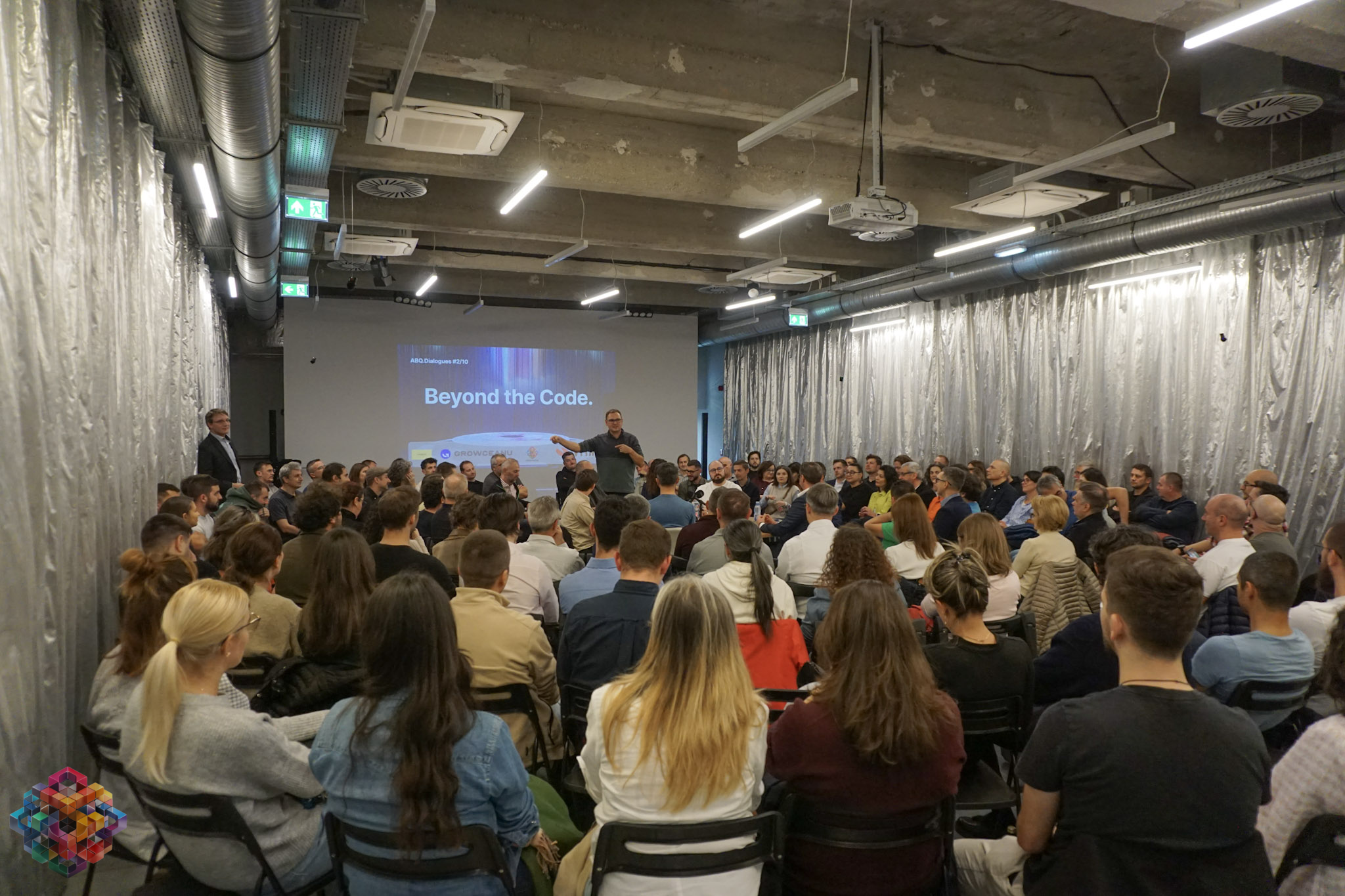
Six industry leaders gathered in Timișoara in January 2025 to examine a question that had been building for two years: as AI automates knowledge work at scale, can Romania transform from a predominantly outsourcing hub into a value-add, product-driven innovation economy? The numbers framing the discussion were stark. Romania's AI adoption rate sat at approximately 2% nationally, compared with 8% across Europe and significantly higher figures in the United States and leading EU markets. Against an adoption gap of this magnitude, the country's outsourcing-dependent technology sector faces pressure that goes beyond competitive disadvantage into existential territory.
The session's organising metaphor was the ouroboros — the serpent consuming its own tail. AI, born from human intelligence and the software industry that built it, now threatens to consume the very jobs and business models that created it. The question was whether this represents creative destruction or genuine cannibalisation, and whether Romania would participate in the creation side or only suffer the consumption side.
The Price Parity Problem
For most of the past two decades, Romania's technology sector succeeded on a straightforward value proposition: skilled engineers at a fraction of Western European rates, with sufficient cultural and time-zone alignment to function as a nearshore partner. This proposition has collapsed. Net salaries in Timișoara have now exceeded those in Barcelona and all of Austria. The price-performance rationale that made Romanian nearshoring attractive has evaporated.
This is not simply a labour market problem. It represents a structural identity crisis for an entire industry. Companies came to Romania for a specific reason — the price-performance compromise — and that reason no longer holds. They are now paying Western European rates for services positioned as nearshore value. Meanwhile, AI tools can increasingly perform the same discrete, execution-focused tasks that made up the core of the outsourcing offer. The two pressures — cost parity from above and automation pressure from below — are arriving simultaneously.
One panelist captured the strategic urgency directly: Romania can no longer sell its time. It has to sell its thinking. The transition is not optional; it is already underway whether the sector acknowledges it or not. Companies that do not move up the value chain toward product ownership, architectural thinking, and genuine IP creation will find the market contracting beneath them.
Why 90% of AI Projects Fail
Andrei Oros, Product Management Director at UiPath, brought one of the session's most clarifying data points: approximately 90% of AI projects initiated in organisations fail or remain permanently stuck in optimisation mode, never achieving genuine transformation. This failure rate is not primarily a technology problem. It is an implementation and change-management problem rooted in a consistent error — forcing teams and workflows to adapt to generic AI solutions rather than adapting AI solutions to specific team contexts and needs.
The insight inverts the common framing. Organisations typically approach AI adoption as a technology procurement exercise: identify a capable tool, deploy it, wait for productivity gains. The 90% failure rate suggests this approach systematically underestimates the specificity of the problem. Effective AI implementation requires deep contextual understanding of how a particular team works, what its actual bottlenecks are, and how the technology can reduce friction in that specific workflow — not in some idealised generic workflow the tool was designed around.
UiPath's internal approach offers a constructive countermodel: provide employees with access to virtually any AI tool available and encourage teams to discover what works for their specific needs and culture. The company generated over 500 ideas for specialised AI agents in a single year through this open experimentation model. The implication for the broader Romanian sector is that AI capability is not the constraint — the capacity to contextualise, experiment, and iterate is.
From Delivery to Architecture
The session produced a clear picture of what the transition to product-led requires — and why it is genuinely difficult. The outsourcing model optimised for delivery: take a specification, execute it accurately and on time, bill by the hour. The product model optimises for architecture: understand a problem deeply enough to define what the right solution is, then own that definition. These are different intellectual operations, different organisational cultures, and different commercial models.
The Palantir model emerged during discussion as an instructive exemplar. Palantir's forward-deployed engineers combine coding skills, consulting ability, and business acumen, speaking directly with clients to understand problems and translating those into solutions in record time. This is not a software delivery role. It is closer to a business intelligence role that happens to produce software. Romania has many people with the raw cognitive capability to operate this way. What it lacks — and what the session identified as the primary constraint — is the cultural permission structure to do so.
Romanian professional culture retains a strong deference to hierarchy. Questioning a client's brief, proposing an alternative architecture, or admitting uncertainty is perceived as weakness rather than expertise. Building a product-led industry requires exactly the opposite disposition: the confidence to challenge assumptions, the comfort with uncertainty, and the ability to own the consequences of recommendations rather than merely executing instructions.
"We can no longer sell our time. We have to sell our thinking."
Six Practitioners, One Consensus
The panel brought together practitioners across the spectrum of Romania's technology ecosystem. Andrei Oros (UiPath) represented the large Romanian-born product company perspective, documenting transformation across engineering, marketing, and HR functions driven by AI capability. Raul Geana (Haufe Group Romania) offered the strategic and leadership perspective, drawing on global experience and multiple startup successes to frame the urgency of adaptation. Daniel Reisenauer (Visma) provided the enterprise software context, managing over 30 clients in AI strategy and describing how the developer role is shifting from pure coding toward product engineering. Voicu Stoiciu (independent consultant and founder) posed the sharpest challenge: the information asymmetry that sustained consulting for two decades has collapsed, and the profession must shift from information delivery to value generation. Dan Damian (Head of AI, Ralph) brought frontline lessons from AI-driven engineering transformation, including the 90% failure rate observation and its causes. Sebastian Males (Eleven Labs London) offered an external reference point, his work on enterprise audio AI platforms illustrating both the pace of capability development and the gap between Romania's current position and the frontier.
Despite their different vantage points, the six reached a consistent conclusion: the outsourcing model is under existential pressure, the transition to product and value-led services is necessary, and the constraint is not capability but cultural and organisational readiness to make the shift.
The Competitive Position in 2026
Looking ahead, the session identified several concrete requirements for Romania's technology sector to remain competitive. First, AI adoption must accelerate dramatically — closing the gap between 2% and EU norms is not a nice-to-have but a precondition for remaining a credible technology partner at all. Second, organisations must establish formal AI experimentation programmes that celebrate learning and accept failure; the cultural disposition toward certainty before action is incompatible with an environment where the tools and best practices are evolving quarterly. Third, the educational pipeline must be redesigned — not just universities, but corporate training programmes that reach the mid-career professionals most at risk in the middle-management contraction that AI is driving. Fourth, and most fundamentally, the sector's self-conception must shift: Romania's advantage in 2026 cannot be cheap labour or even skilled delivery. It must be contextual intelligence — the ability to understand problems deeply enough to build products that other people want to use.
As one panelist summarised with uncomfortable directness: empires fall when they do not adapt. The companies and regions that identify what truly matters and concentrate resources there will succeed. The question for Romania is whether the sector can generate that strategic clarity before the pressure becomes irreversible.
Cite this analysis
ABQ Institute. "Romania's Tech Industry at the Crossroads — From Outsourcing to Product-Led." ABQ Dialogues Season 1, #2. Timișoara, Romania: ABQ Institute, 2025. Available at: https://abq.institute/insights/romanias-tech-industry-at-the-crossroads