Key Findings
- Blockchain's most tangible economic value is infrastructure, not speculation: stablecoins protecting savings in high-inflation economies, bond issuance, and faster B2B settlement are its clearest proven applications in 2025.
- Only 3% of Romanians had adopted AI-using applications at the time of this session versus 14% EU-wide; Romania's social trust level of 12% (compared to 74% in Denmark) creates a structural barrier to technology adoption that no app can bridge alone.
- Power to code "the new economic reality" is concentrating among those who build AI and blockchain infrastructure — the central accountability question is not technological but political: who governs the systems that govern us?
Beyond the Hype Cycle: What Actually Creates Economic Value
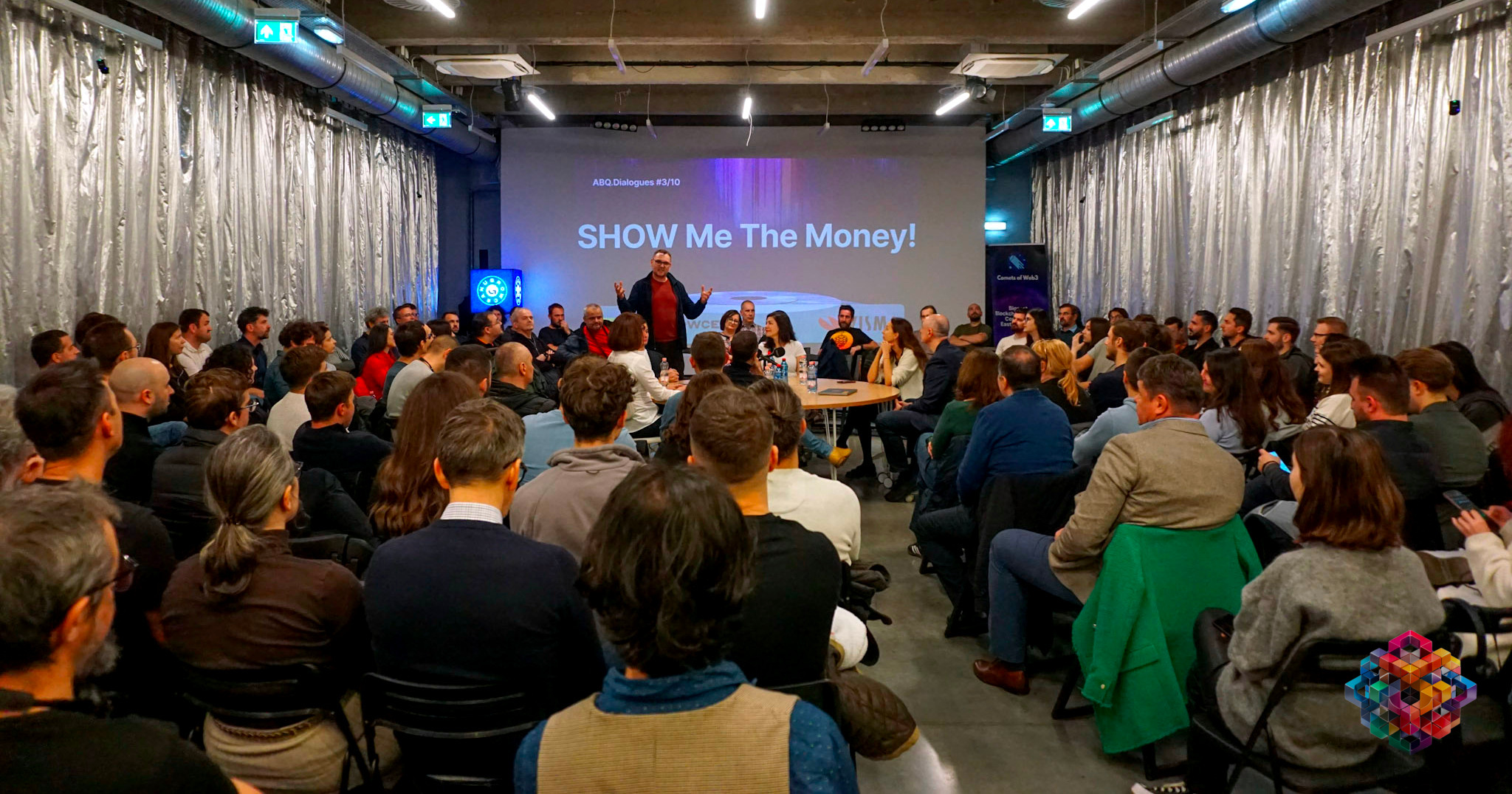
For centuries, lawyers have been the silent coders of capitalism, drafting the legal architecture behind every currency, asset, and financial product. Now that code is being rewritten, and the third ABQ Dialogues session asked the bluntest possible question: where is the real economic value in AI and blockchain, stripped of the hype? Six panelists from across the financial and technological ecosystem gathered in Timișoara to examine this question from radically different vantage points — and arrived at an answer that was less glamorous, and more consequential, than the technology press typically suggests.
The session's honest starting point was the gap between the narrative about AI and blockchain and their actual penetration in the Romanian economy. Only 3% of Romanians had adopted applications that use AI at the time of the session, versus 14% EU-wide. Blockchain, despite nearly a decade of headlines about disrupting banking, is largely invisible to end users precisely because its most valuable deployments are infrastructural. The question was not whether these technologies create value — they demonstrably do — but where that value actually sits and who captures it.
Stablecoins as Infrastructure, Not Speculation
Daiana Mărculescu, who led an ecosystem of 250 people across five countries and managed a $40 million annual treasury, provided the session's clearest answer to where blockchain's concrete economic value lies: not in speculative cryptocurrency trading, but in the unglamorous work of protecting savings and settling transactions reliably. "Blockchain is fundamentally a new database architecture," she explained. "Changes happen at the infrastructure level and happen more slowly. It's not as visible to end users."
The stablecoin use case crystallised this. In countries with high inflation — Venezuela, Nigeria, places where governments cannot keep economies stable — stablecoins allow citizens to protect their savings without requiring access to physical dollars or a foreign bank account. They go online, buy digital currencies maintained at dollar value globally, and their savings retain purchasing power month to month. This is not a luxury product for crypto enthusiasts. It is financial survival infrastructure for populations whose governments have failed them economically.
Ionuț Stanimir from BCR confirmed that blockchain's B2B applications are already well-established in banking: BCR's parent group issues bonds on blockchain and conducts international financing on blockchain. "But it's infrastructure," he emphasised, "something you don't see." The practical implication is that blockchain's most defensible economic value is precisely the kind that does not generate headlines — faster settlement, reduced correspondent banking overhead, and programmable transaction logic that eliminates layers of manual reconciliation.
The Adoption Gap and the Trust Problem
The 3% versus 14% adoption gap is striking on its own. But the session's most structurally important data point came from Ioana Hațegan, the international corporate lawyer: Romania's social trust level sits at 12%, compared with 74% in Denmark and 50% in Austria, according to the 2024 Integrated Values Survey. This is not a peripheral data point. It is the explanatory variable that underlies much of the adoption gap.
Technology adoption at scale requires trust — trust in institutions that hold data, trust in platforms that mediate transactions, trust in the legal frameworks that govern disputes. When only 12% of a population extends trust beyond their immediate circle, every digital service that asks for personal data, financial information, or behavioural patterns faces a structural headwind that no user interface improvement can overcome. Romania's social trust deficit is not primarily a technology problem. It is a consequence of decades of institutional failure, and it imposes a measurable cost on the country's capacity to benefit from the digital economy.
The trust problem compounds in the AI context. Hațegan cited sobering social statistics: one in four Romanian children goes to bed hungry, and 60% abandon school before age 15. These realities shape the adoption environment in ways that purely technological analysis misses. An AI product designed for a population with high institutional trust and digital literacy faces a fundamentally different adoption challenge than the same product deployed in a low-trust, high-inequality context.
Who Codes the New Reality?
The session's most politically charged exchange occurred around a question posed by Ionuț Stanimir near the close of the discussion: who has the power to code the new economic reality? The question was not rhetorical. AI and blockchain are infrastructure technologies — they do not merely enable transactions but define the rules under which transactions occur, the terms on which verification is conducted, and the conditions under which value can be transferred or withheld.
The lawyer in the room framed the accountability question directly: AI used at the scale of healthcare, legal services, and financial infrastructure embeds value judgments into systems that affect millions of people. Those value judgments — about who counts as creditworthy, whose data is valid, whose identity deserves verification — are made by the small number of individuals and organisations who design the systems. The democratic question is whether the people affected by those systems have any meaningful input into how they are designed or governed.
Adi Erimescu, co-founder of Imobiliare.ro and the Growceanu investment platform, illustrated both the democratising potential and the concentration risk from the investment side. In 2005, his only financing option was a single buyer. Today, a founder can upload a pitch deck, have AI ensure completeness, and reach investors who can complete an investment in five minutes. Venture capital funds require minimum tickets of €200,000–250,000; crowdfunding legislation allows retail investors to build a startup portfolio with €5,000. The infrastructure has genuinely democratised. But the entities building that infrastructure still control its terms.
"The blockchain you'll use won't feel like blockchain. It will feel like a bank transfer that actually works."
Six Voices at the Table
The session's analytical depth came from the breadth of the panel. Ionuț Stanimir (Marketing Director, BCR) approached finance through a sociological lens, asking not just how technologies work but who they include and exclude. Daiana Mărculescu (Blockchain Leader) brought the credibility of having managed a $40 million blockchain treasury and led a global team, cutting through speculation to identify where the technology actually delivers. Ioana Hațegan (International Corporate Lawyer) provided the legal and accountability perspective, consistently redirecting discussion toward the unglamorous but essential questions of compliance, governance, and what happens when systems fail. Mihai Brenda (Fintech Entrepreneur) illustrated how blockchain enables business models that were previously impossible — his current project digitises barter compensation using smart contracts, a practical application that would have required enormous paper infrastructure before. Andreea Lutz (Accounting Partner) represented the profession most immediately disrupted by automation, offering an honest account of reluctant adoption driven by regulatory mandate rather than enthusiasm. Adi Erimescu (ABQ Institute) synthesised across the financial ecosystem, connecting investment infrastructure to the broader question of how Romania builds technological capacity at scale.
The Question We Didn't Fully Answer
The session's final exchange acknowledged an important limit. The question of who governs the systems that govern us — who decides the rules embedded in AI models, who audits blockchain protocols, who holds accountable the organisations building financial infrastructure — was raised clearly but not resolved. This is appropriate. The accountability question cannot be resolved in a single evening or a single regulatory cycle.
What the session did establish is that the question is fundamentally political, not technological. AI and blockchain do not automatically democratise or concentrate power. They amplify the distribution of power that already exists in the societies that deploy them. In a low-trust environment with weak institutions and a 12% social trust baseline, the risk is that the efficiency gains from these technologies flow primarily to those who already have the resources to deploy and govern them — while the populations most in need of financial inclusion remain structurally excluded. The conversation must continue, and it must include voices from outside the technology industry.
Cite this analysis
ABQ Institute. "Show Me the Money — The Economic Value of AI and Blockchain." ABQ Dialogues Season 1, #3. Timișoara, Romania: ABQ Institute, 2025. Available at: https://abq.institute/insights/show-me-the-money